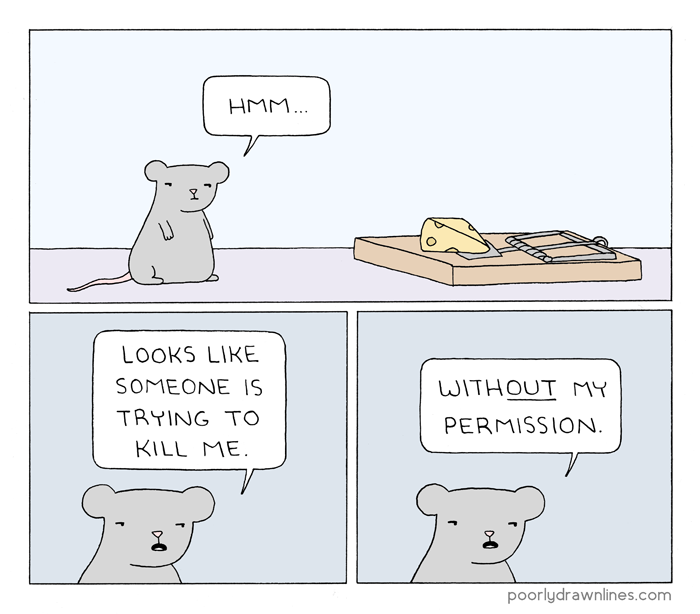
My Battery Is Low, and It’s Getting Dark

Ladies and gentleman, we’ve made it. I regret to inform all of my countless fans around the world that this will, unfortunately, be my last blog post which deals with Poorly Drawn Lines and professional commentary on webcomics. But enough with the sentimentality—let’s get to it. 

For this final blog, I read two of Lee Atchison’s posts on his website “Sequential Tart” which dealt with the history and growth of webcomics throughout history. Atchison covers a wide berth of years, from the very first digital comic The F.O.X in 1986, to the first webcomic Doctor Fun in 1993, to the more current webcomics such as xkcd and The Order of the Stick. Atchison outlines how future comics built on the examples of the past, as well as how critics such as Scott McCloud in 2000 hypothesized the direction webcomics would go. 

In terms of advancement of webcomics, Poorly Drawn Lines is pretty prehistoric. The site is static, there is no use of any digital affordances such as the infinite canvas or alt-text, and the subject of the comics themselves are, for the most part, timeless. However, by using the waybackmachine, it is intriguing to look at how the comic—and author—itself has changed. 

Poorly Drawn Lines started in 2008 as a side project of Reza when a college student at UCSD. At the time, Reza’s humor was much more in line with a college student. While I cannot see the comics themselves, the “About” and “News” pages provide enough insight. His about page mentions, “If you are at any time offended by the words and/or images that appear on this website, please promptly remove yourself from the immediate vicinity of your computer and go read a fucking book”, while his news page contains articles like “Brain Juice”, which is only a single sentence “I actually know a guy who drinks before exams pretty often”. 

Fast forward to today, and Reza is creating comics to teach young voters how to vote and writing news stories (now under “blog”) giving his fans updates on his book and other happenings with the comic. The closest thing to immaturity present is his blog on what music he listens to while drawing (but that is a massive stretch to consider immature). The growth of Reza himself provides a whole new way to look at the history of webcomics—and brings up the important point that growth is not measurable throughout the genre, but in individual cases as well.  

Defining Serial Characters (but not those in the podcast)

For today’s blog I read “Girl, You’ll Be an Invisible Woman Soon: Defining Serial Characters”, a blog post by Osvaldo Oyola. Oyola talks about recurring characters in comics, specifically Susan Richards (the Invisible Woman) in the Fantastic Four series. Oyola examines how the viewpoints of the time (in this case, the misogyny prevalent in society) can be, and usually are, represented in the comics of that generation. She shows how the Invisible Woman, while just as valuable a team member as any of the other Fantastic Four, is viewed as a weak woman first and a superhero second. For example, in issue #14, Richards insists on “[doing] a little housecleaning!” while the rest of the crew relaxes on the couches after a tiring mission. 

While this sentiment is definitely true for characters in comics with a defined storyline, I was curious to see whether the same correlation could be found with semi-serial characters, such as Kev and Ernesto in Poorly Drawn Lines. Because the characters do not appear in every strip, and the names of comics do not always hint at the parties involved, I was worried finding multiple strips with the characters would be challenging. However, thanks to Instagram’s waffle board view option, I was able to quickly compile a small collection of comics including Kev and Ernesto. For simplicity sake, I decided to focus solely on Ernesto. 

Upon perusing the collection, I realized that semi-serial characters such as Kev and Ernesto are not defined in the same way as Susan Richards and other serial characters. In earlier comics, such as “Ernesto’s song” from 2016, the bear appears as an abstract, inquisitive character.  

Ernesto’s abstract questions give his character a sense of intellect and mysteriousness

This is reiterated in “Ernesto’s theory“, “Reasons“, and “Cool Hat“, among others. However, this characterization doesn’t change or even continue, rather just disappear. In more recent strips, such as “the ocean” or “new stuff”, Ernesto is displayed as simple-minded, even using incorrect grammar when questioning “what if it goes badly?” While there are certain instances when societal viewpoints appear in the character’s dialogue (the General Mills Cookie Crisp incident in “Reasons”), there is no overall societal norm that any semi-serial character is defined by. 

Hyperbole vs. Linear: The Ultimate Time Battle

While I love examining community in Poorly Drawn Lines, this blog will focus on both a different webcomic. Allie Brosh’s “Hyperbole and a Half” covers a wide range of topics including the power of a dinosaur costume, fun games to play with a brick, getting lost in the woods, and her personal battle with depression. For this post, we were required to read two of Brosh’s last posts, “Adventures in Depression” and “Depression Part Two”. These posts outlined the struggles Brosh went through with her depression, both the feelings (or lack thereof) she experienced as well as illustrating how non-depressed people overgeneralize the situation and can often make it worse.  

Through interacting with both the print and digital forms, the main difference I noticed was the concept of linearity. Digitally, it is very easy to track how Brosh’s depression affected the comic—the first two years of its existence boasted a combined 157 posts while 2011 contained only five, the last of which being “Adventures in Depression” in October. The next post, “Depression Part Two”, didn’t arrive until over a year later in May 2013. While it may not have been a conscious choice, the time between posts and general transition to a bunch of happy and funny posts early in the comic’s career to only a few dark posts as time progressed impacts the feel of the comic. No longer is the comic simply a collection of various random and silly life events, but instead a complex and personal account of Allie Brosh’s life.  

Brosh’s post count dramatically decreases as her battle with depression heightens

However, Brosh completely strips away this feeling in the print edition. The first thing I did when sitting down to read it was check for “Depression Part Two” on the last few pages. However, to my surprise, it wasn’t there. Instead, I found both comics dealing with depression starting on page 99, less than a third of the way through the book. By abandoning the linearity found in the digital version, Brosh completely changes the feel of the comic. Because the episodes are just shoved between two other comics you would most likely read right before and after, the story loses much of its weight and significance. While I haven’t discovered the reasoning for this decision, it goes to show how the natural tendency of webcomics to be displayed in a linear fashion can completely change the feel of a story. 

The second to last comic in the print edition, “The Party”, was originally posted in September 2010

Maybe Digital Isn’t That Different…

For today’s reading, I analyzed Margaret Galvan’s “‘The Lesbian Norman Rockwell’: Alison Bechdel and Queer Grassroots Networks”. In this article, Galvan looks at how different queer communities affected the popularity, spreadability, and consumption of Bechdel’s comic. While Galvan employs many different angles to examine these factors, I am going to focus on a specific aspect of the article—how the archives that have influenced Bechdel’s works have had a similar effect on Poorly Drawn Lines. 

In the first sentence of the section on archives, Galvan mentions, “Archives are not simply an aesthetics of Bechdel’s work: she…actively creates her own archives to store material that otherwise might not be saved” (415). This is an interesting point to consider in the now digital age—back when Bechdel was creating her comic strips, everything was done in print. The comics were drawn on paper, printed in the paper, and then stored on paper. The act of saving a piece of work was much more involved than today; artists had to make a conscious effort to store all of their own comics (and deal with the ensuing clutter) instead of throwing them out the second they were printed. While the task was a more conscious one, it was a necessary one. As Galvan states, “Archives in general allow us to read comics with a new fullness and to see the personal networks surrounding their creation” (418). 

An example of Bechdel’s work

In today’s world, the process of putting together an archive seems much less effortful. As webcomics are posted digitally, and since services like the wayback machine exist, there are countless records of everything an author posts. It is much harder to “throw away” work. This led me to believe that archives today have lost some of their importance, as the process of deciding what to include in said archives is no longer necessary. However, the wayback machine tells a different story. On the current Poorly Drawn Lines website, the oldest archived comic that exists is “Hardly Essayists”. However, in the Feb 14, 2009 capture, “Hardly Essayists” is the 4th most recent comic. There are 37 comics posted earlier than it. This means that, even in the digital age, artists are still consciously choosing the comics they are saving. Even in an age where saving comics is as easy as the click of a button, the beauty and importance of archives lives on. 

Community Building with Poorly Drawn Lines

For today’s blog, I read “Imagined Communities” by Benedict Anderson. In this chapter, Anderson talks about community building through literature. Anderson highlights how this is not an American phenomenon, and proceeds to give four examples of international literature in which the opening chapters immediately foster a sense of community between not only the characters in the literature but also the readers. Anderson uses Noli as an example, in which the author uses an unnamed hero referred to only as “our hero” so that “Neither Marco nor his readers have any doubts about the reference” (Anderson 32). 

Additionally, Anderson goes on to mention how newspapers fit into this picture of building community. To Anderson, newspapers are simply books that are massively produced but only for a very short period of time, a “one-day best seller” in his words. Anderson goes on to mention how, even though most consumers read the paper alone, each person is aware of the countless other people around the world also performing this same “ritual”. This subconsciously builds a sense of community in the readers, as even though the events in the paper are disconnected all readers can take comfort in the fact that millions of other readers are reading the same story. 

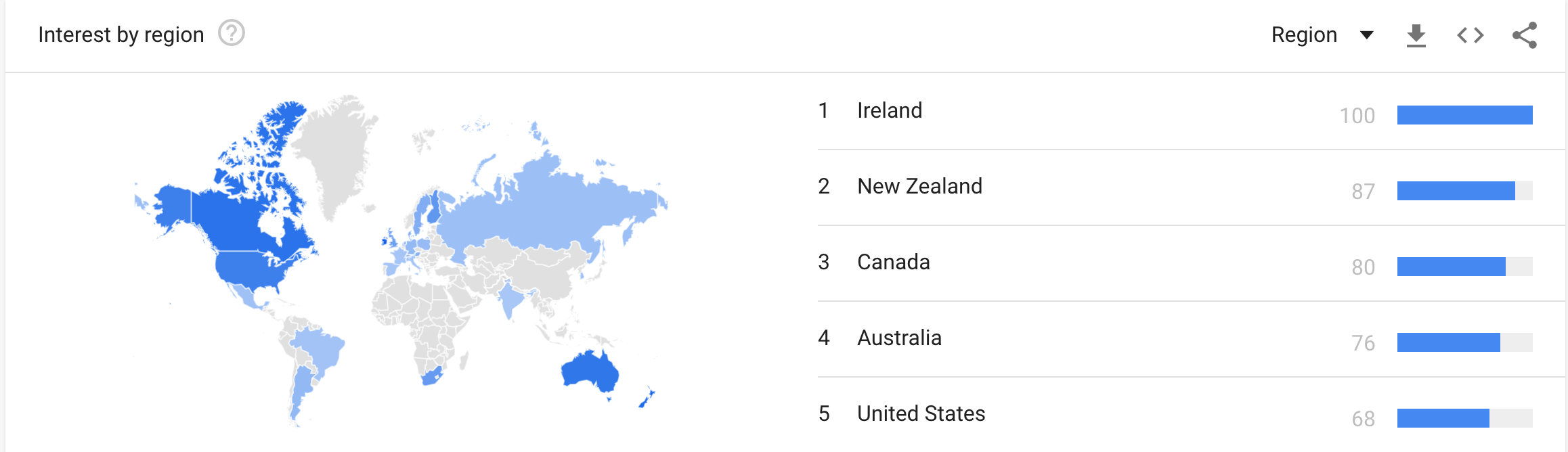
To this end, I feel webcomics fit into the same category as newspapers. Especially series such as Poorly Drawn Lines where each comic exists in its own storyline, it is hard to build a sense of community through plot. However, as Anderson mentions with newspapers, Poorly Drawn Lines builds its community through the feeling of a shared experience. By created social media accounts with hundreds of thousands of followers (Instagram with 1.1M, Facebook with 967k and Twitter with 121k), users can interact through the comments section with hundreds of other users about the comics. Additionally, Poorly Drawn Lines is has a much larger international audience than I originally thought. To truly get a sense of the size of the community, I searched “Poorly Drawn Lines” in the google trends portal. To my surprise, the United States isn’t even in the top three countries. The ability of Poorly Drawn Lines to build its community through social media allows the comic to reach even international audiences, creating an even larger fanbase for users to interact with and become more comfortable with. 

As google explains, “Values are calculated on a scale from 0 to 100, where 100 is the location with the most popularity as a fraction of total searches in that location, a value of 50 indicates a location which is half as popular.”
THE BEST OF DAY 8: MY FAVORITE COMICS FROM RANDOMLY SURFING POORLY DRAWN LINES

What Makes A Webcomic A Webcomic

Friday’s presentations brought up a lot of new tenets to consider, as well as interesting discussion on not only what makes a webcomic, but how we must first agree on a definition before we can decide what should be included in our exhibition. Without a concrete definition of what makes a good webcomic, it will be impossible to choose from all of the very unique comics that were presented during the week. 

The point I want to go more in depth on is Ruarai’s argument on what defines a webcomic. To him, the importance of the webcomic depended not on the digital affordances it took advantage of but on the content of the comic itself. While I see the validity in his statement (and by his logic, Poorly Drawn Lines would be a better-than-average example of a webcomic), I have to respectfully disagree. I believe the ability to use the infinite canvas, alt-text, or even the ability to collaborate with fans on social media and other sites is what makes webcomics webcomics. To examine these comics based only on the content they contain would provide no extra insight into the world of webcomics—the ideas we choose to display could just have easily been formed from reading print comics.  

A screenshot of Xkcd's "Right Click" which opens up a panel of countless little mini games to explore
If we were to analyze xkcd based only on what could be printed in a book, we would miss out on a main aspect of the comic

While I do feel that webcomics are defined by their web aspect as much as their comic aspect, this does not mean our exhibition should focus solely on comics which take complete advantage of the web. To truly examine webcomics and how the internet has affected them, we must consider comics from all subsets—both those that focus more on content as Ruarai suggests as well as those that focus on web design as I previously stated. Therefore, there are a few themes I feel are necessary for our exhibit. The first is the impact of the web/social media on the comics. All of the comics presented either mentioned social media or sites like Patreon, and I believe it is important to analyze the impact these sites had. Additionally, I think we should examine collaboration (or lack thereof) with fans, especially since The Loneliest Astronauts had a great deal of collaboration only to fail years later. Finally, we must highlight the impact of a regular post schedule. While not the deepest theme, almost every presentation mentioned it in some form, making it too important and widespread to overlook. 

THE BEST OF DAY 7: MY FAVORITE COMICS FROM RANDOMLY SURFING POORLY DRAWN LINES

Why Poorly Drawn Lines May Not Be the Picture Perfect Comic After All

Wednesday’s presentations brought up some new and interesting points on webcomics I hadn’t previously thought about. All of the presentations on Monday followed a pretty similar mold—most focused on a well-known, American comic which (for the most part) posted on a regular schedule and focused on mainstream topics. However, the comics presented on Wednesday completely broke this mold. Not only did we have comics which embodied a more fluid genre, but also had examples of comics that were important not for their success, but for their failure.  

Before these presentations, the webcomics I had been exposed to led me to believe that the medium was mainly popular in the United States. However, Dragon Ball Multiverse and Cheese in the Trap prove that webcomics are a much more universal idea. In the times of today when technology and the internet is found almost everywhere in the world, webcomics are can be easily created and shared by anyone from anywhere. Dragon Ball Multiverse has been translated into over 30 languages. This is especially important when planning the exhibit, as including only well-known American comics would cause the exhibit to potentially lose a large portion of its guests who focus on international comics. Additionally, the medium allows otherwise marginalized audiences to have a voice. Both Girls with Slingshots and Joey Alison Sayers allow for LGBTQIA+ groups to express themselves and create a fanbase who not only support the comic but also the author and each other as well.  

The title slide of a voting ad created by the authors of many well-known comics
This “dream team” comic has both its upsides and downsides. While it does allow for a certain group of people to get their voice out (the rest of the comic leans democratic), it also ignores the large international audience the various comics may have accumulated.

Wednesday’s presentations also brought up a good question of success vs. failure. As John mentioned in his presentation on “The Loneliest Astronauts”, it may be just as important to include comics in the exhibition that have failed as well as ones that have had massive success. “The Loneliest Astronauts” website is hanging on by a thread, and the reasons behind the failure of the comic’s popularity after the completion of the story is an important question to answer in order to really discover the role webcomics play in our society. Why a comic with a humorous, complex storyline would fail when a comic that uses the exact same artwork every time (looking at you, Dinosaur Comics), becomes wildly popular is an issue worth analyzing. 

The best of day 6: My favorite comics from randomly surfing Poorly Drawn Lines

*Insert Witty Title About Monday’s Presentations Here*

This blog, instead of focusing on a certain article or comic from Poorly Drawn Lines, will be focused on responding to the presentations viewed in class today. Throughout the presentations, there were tenets that many of the presenters focused on, as while as some that were unique to specific comics. 

The tenet that was most widely talked about, which was also included in my presentation, was the importance of a regular post schedule. This does make sense, given a quote from Misemer’s “Webcomics”. In the article, Misemer quotes a source which postulates that “series are generally most successful when they post new content on a regular schedule” (Guigar, et al. 2014). As all the comic we have been studying can be considered successful comics (as otherwise, there is a good chance we would not have found them). However, I think this tenet alone is not that powerful of a statement. What makes it powerful is how it feeds in to other tenets. If a comic were to not post on a regular schedule, it would be near impossible to maintain a dedicated fanbase. Let’s be honest, people are lazy. If fans were unsure when to expect content, they would be forced to sit on the page constantly checking if something was posted. However, a regular post schedule lets people know when to check. They not only can be confident they’ll find something new every time they go on the site, but the author can create a sense of excitement and anticipation when leaving a storyline unfinished for a few days. By creating a post schedule this anticipation can be contained, as fans who are left on a cliff hanger with no promise of an ending will more likely be angry than excited (*cough*cough*Patrick Rothfuss*cough*cough*). 

I like to think that maybe this is how Reza keeps up with such a busy post schedule
Alt-text can be pretty helpful…

Additionally, it was interesting to see how other presenters’ comics differed from mine. The one comic I found very similar—Hanes’s “Hi, I’m Liz…”—had very similar ideas and tenets to mine. While we disagreed whether a comic of our nature should be in the exhibit, it made the point that even webcomics themselves can fit into different subsets and categories. Comics like Eric’s “The NIB”, which was entirely different, had completely different tenets. This will be an important distinction to make when preparing for the upcoming exhibition, and will have to be a consideration when choosing which comics to include. 

The best of day 5: My favorite comics I didn’t have time to show in my presentation

How Poorly Drawn Lines Changes Economics

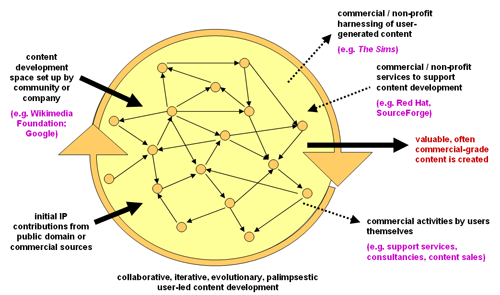
In Blogs, Wikipedia, Second Life, and Beyond by Alex Bruns, the second chapter focuses on how the producer to consumer path has historically been traversed, as well as how the internet has altered this line to become more of a cycle. Bruns goes on to define a new type of production called produsage, in which the role of the producer and consumer are combined to create a user-based type of creation in which users collaboratively build on current iterations to further develop a product. 

While Bruns ties this new form of production to the expansive realm of the internet, his claim is not entirely valid. This is because the entire produsage “cycle” is based on a single tenet—explicit collaboration. I personally feel there are two different types of collaboration, implicit and explicit, an idea Bruns indirectly mentions in his book. Explicit collaboration is the type of collaboration connected with produsage and is more commonly found the internet—the type of collaboration that involves the users’ directly interacting with the authors/producers in some way to change the output. Implicit collaboration is connected to the historical production path—the type of collaboration that involves the consumers choosing which products to consume and, therefore, implicitly stating which products are superior to others. 

A diagram explaining how produsage works
A diagram of the produsage cycle

Because the baseline definition of produsage relies so heavily on the explicit collaboration cycle, it restricts itself from an entire realm of online media, for instance the Poorly Drawn Lines webcomic. Poorly Drawn Lines is one on the webcomics that has no explicit collaboration. Yes, it is possible to contact the author, but this ability seems to be geared more towards general questions than collaboration idea. Thus, the comic follows the more historical production cycle. The author produces content, posts it to the website, and decides how/what to create the next comic based on the comments and likes it receives (1). While the internet is the reason produsage exists, it does not signify the end of the historical production cycle (as Bruns suggests). As other articles I have examined illustrate, the desire to keep webcomics in a printable form have kept some artists from taking advantage of the digital mode, therefore implicitly choosing to continue in the old, non-collaborative way of life.

1) I can only guess this is the way it works, as I am not Reza Farazmand nor do I have the ability to read his mind (unfortunately)

The best of day 4: My favorite comics from random stages of Poorly Drawn Lines

A Short Blog, but a Long Analysis

On this episode of Teddy Analyzes Poorly Drawn Lines, I read “(SP)READING DIGITAL COMICS” by Geoffrey Long. In this article, Long examines how the nature of the digital mode allows for easier sharing and dissemination of comics. During his childhood, the only way to get new comics was to go to the comic book store or look through a friend’s collection—both which require face-to-face interaction. However, in the digital age we live in today, sharing comics is as easy as copying a link, screenshotting a page, or clicking the share/social media buttons now common on webcomic sites. This allows the author to bring in revenue digitally, either through ad revenue and/or a webstore. 

The website which hosts Poorly Drawn Lines fits Long’s description to a T. The main page of Poorly Drawn Lines features the most recent comic released, multiple ad panels at both the top and bottom of the page, and various tabs to different locations on the website. Nestled in the top right corner of the page are buttons which allow new fans to follow the official Facebook and Twitter page, as well as an RSS feed visitors can subscribe to. This allows PDL to grow its audience much faster than other web-only comics. Not only can users now share URLs, but also repost and direct message posts the author puts on social media. By doing so, Poorly Drawn Lines has gained a massive following, with hundreds of thousands of people following the various social media accounts. All of this sets the comic up to start the next phase Long mentions—monetizing the comic. 

A screenshot of the Poorly Drawn Lines website
A screenshot of the Poorly Drawn Lines main page. It is interesting that the PDL Instagram has the most followers of any of the accounts (1.1M), yet there is no button to follow it

Of all the webcomics I have looked at over the years, Poorly Drawn Lines seems to have the most expansive sales portfolio. Even before clicking on the “Store” tab from the main page, a large yellow box (which greatly contrasts the blue and green background of the site) advertises a direct link to purchase the author’s newest book. Yet book sales are only the tip of the iceberg. Once in the store, you have the option to buy prints, more books, pins, mugs (which feature entire comic strips), t-shirts, and even bags. The pins have been so popular in the past that within minutes of them being restocked, they were once again sold out. And not only do sales bring in money, but they also continue to spread the comic. No longer is the comic’s popularity restricted to the digital mode—it can now exist in the real world as well. 

A tote bag reading "everything looks nicer in ribbons motherfucker", which is all written in ribbons
While it probably has the least actual relation to the comics, this is hands down the best tote bag on the site
The best of day 3: My favorite comics from random stages of Poorly Drawn Lines