
Friday’s presentations brought up a lot of new tenets to consider, as well as interesting discussion on not only what makes a webcomic, but how we must first agree on a definition before we can decide what should be included in our exhibition. Without a concrete definition of what makes a good webcomic, it will be impossible to choose from all of the very unique comics that were presented during the week.
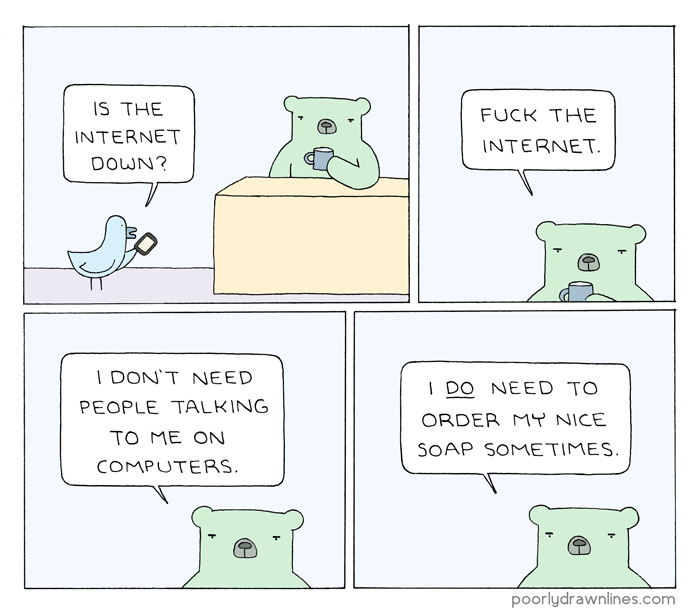
The point I want to go more in depth on is Ruarai’s argument on what defines a webcomic. To him, the importance of the webcomic depended not on the digital affordances it took advantage of but on the content of the comic itself. While I see the validity in his statement (and by his logic, Poorly Drawn Lines would be a better-than-average example of a webcomic), I have to respectfully disagree. I believe the ability to use the infinite canvas, alt-text, or even the ability to collaborate with fans on social media and other sites is what makes webcomics webcomics. To examine these comics based only on the content they contain would provide no extra insight into the world of webcomics—the ideas we choose to display could just have easily been formed from reading print comics.

While I do feel that webcomics are defined by their web aspect as much as their comic aspect, this does not mean our exhibition should focus solely on comics which take complete advantage of the web. To truly examine webcomics and how the internet has affected them, we must consider comics from all subsets—both those that focus more on content as Ruarai suggests as well as those that focus on web design as I previously stated. Therefore, there are a few themes I feel are necessary for our exhibit. The first is the impact of the web/social media on the comics. All of the comics presented either mentioned social media or sites like Patreon, and I believe it is important to analyze the impact these sites had. Additionally, I think we should examine collaboration (or lack thereof) with fans, especially since The Loneliest Astronauts had a great deal of collaboration only to fail years later. Finally, we must highlight the impact of a regular post schedule. While not the deepest theme, almost every presentation mentioned it in some form, making it too important and widespread to overlook.


 Poorly Drawn Lines and Well Written Blogs