Just wanted to share a friendly little tip I found. Each frame of the online version of homestuck is generated as its own webpage. What this means is that if you are senseless like me and didn’t save your progress before quitting, ALL HOPE IS NOT LOST.
Time to go hacker mode
Look at the top of the screen where the url is. It looks like
https://www.homestuck.com/story/267
What’s important here is that number at the end. The 267. Believe it or not, that is the “page” you are currently on. Change that number, and you are instantly transported to that part of Homestuck.
So if you forgot to save, type the above url in your search browser, and guesstimate where you think you left off. Get to a page you’ve seen before? Just raise the number! Page look unfamiliar? Lower it!
You can now continue reading Homestuck from any point without having to worry about the silly save feature 😎
Okay, I’m going to start out by being completely honest—from what I have read so far I have ≈1% clue what is currently going on in Homestuck. I am one of the minority(?) who had not heard of Homestuck before this class. Whether that be I haven’t gotten to the main plot yet, the references are going over my head, or some other variable I am not even accounting for, it took me about 15 minutes of deep reading various wiki articles about the series before I could start to piece the storyline and canon of it. Regardless, here’s my ~expert~ analysis.
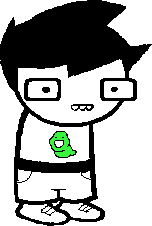
John’s expression exactly matches mine while trying to understand Homestuck
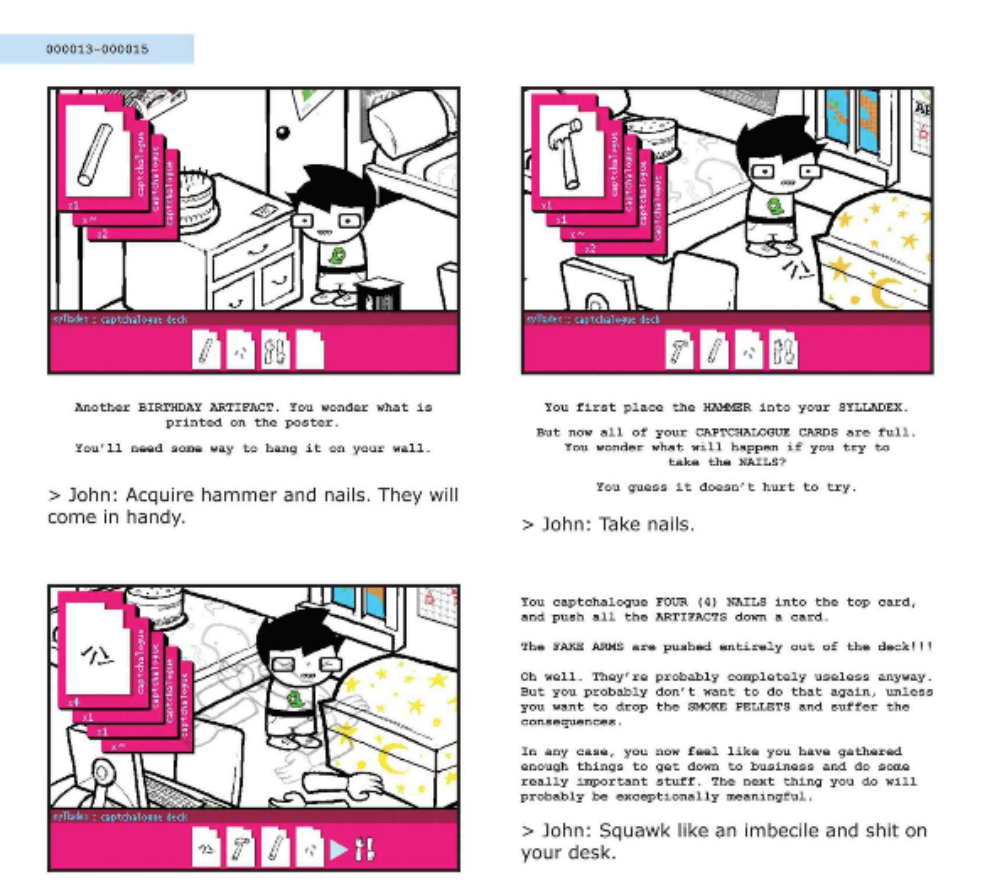
My first interaction with Homestuck was the print version. Once I picked it up from Barnes and Noble, I skimmed through the first few pages to see just what I had gotten myself into. After reading a few pages, I was under the impression the online version was much more user input-based. It wasn’t until I actually went to the online version that I realized my mistake. Still, however, I believe Homestuck is a webcomic that deserved to stay as a web-only version. The flash sequences, as well as the slides that contain sound, even the animations lose much of their appeal when printed as static images. While the print version has been wildly popular, I believe this more has to do with the crazy fanbase consuming anything and everything Hussie creates rather than the print edition being an actual working copy of the comic.
Without animation, Hussie is forced to use opacity to represent motion in the print edition—a factor I personally think greatly impairs the flow of the work
It is, however, interesting to see that Homestuck directly contradicts Kashtan’s claims in “Click and Drag”. Near the end of the chapter, Kashtan remarks, “A webcomic that uses the sort of digital-specific features McCloud advocates is less viable as a printed book than a webcomic that doesn’t. This factor may help explain why popular webcomics avoid digital-specific features…” (107). Homestuck does not follow this rule. Aside from the infinite canvas and alt-text, Homestuck exploits all the affordances the digital medium allows. However, this proves that the comic itself does not make or break its success. In the end, it comes down to the size of its fanbase, and their willingness to consume media created by the author, no matter the form.
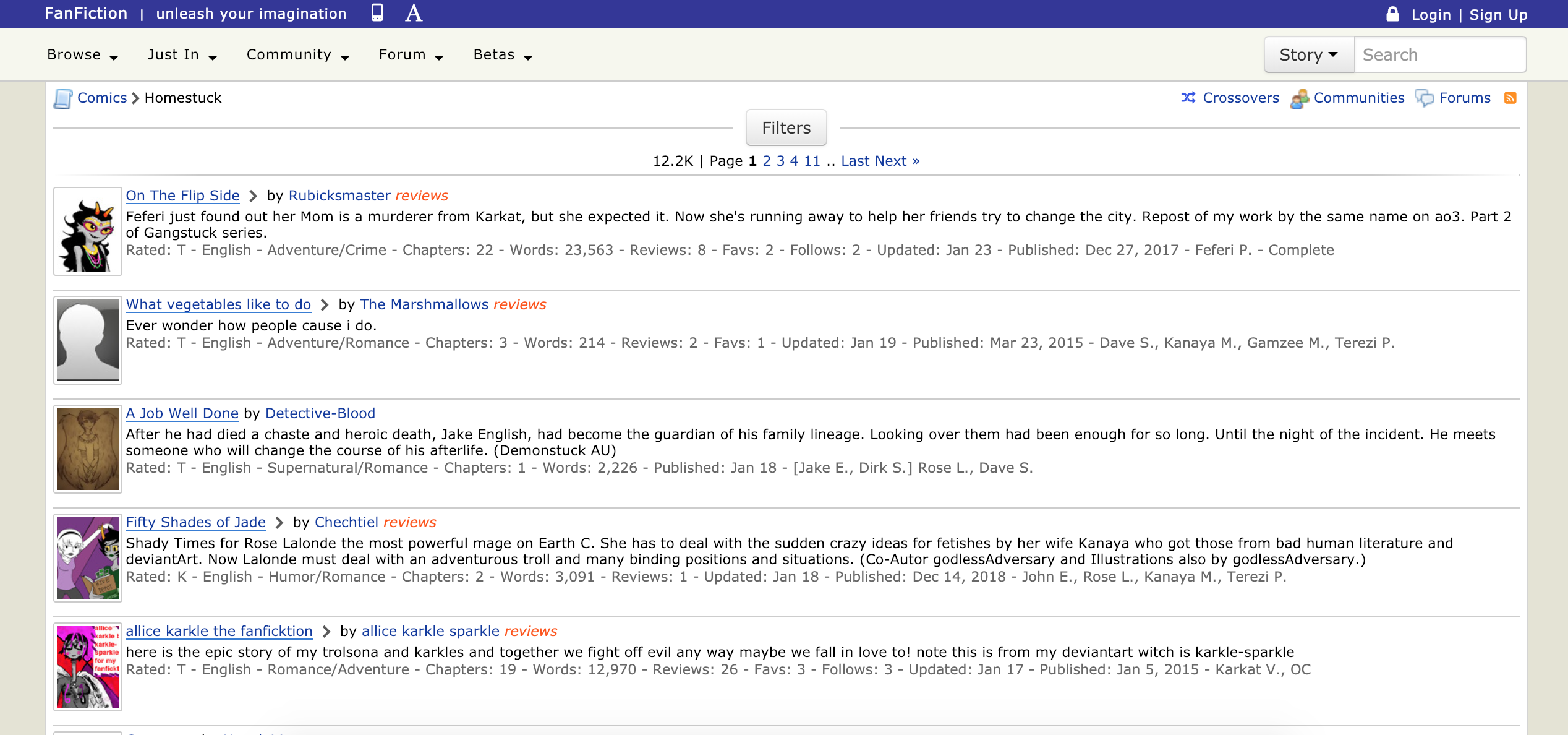
A quick search for “Homestuck fanfiction” reveals the fanfiction.net website with over 12,200 entries
For today’s blog, I was tasked with reading and analyzing Aaron Kashtan’s “Click and Drag”. In this work, Kashtan argues against multiple claims made by a fellow analyst Scott McCloud. Among other things, Kashtan refutes McCloud’s claims that digital comics will cause the end of print media, as well as the idea that webcomics have no significance in the world of ink and paper. It is very important to note that McCloud’s claims were published in 2000, a time before Instagram, Twitter, and Kindle E-readers greatly changed the way in which users consume digital media.
The claim that Kashtan spends the most time refuting, which is also the claim McCloud advocates for the most, is that webcomics will render print irrelevant as “tactile contact with works of art is no longer required” (Kashtan 91). This is a major prediction—especially in an age when e-readers like Kindles and Nooks would not be invented for another 5-7 years. If McCloud were to be correct, it would spell the end to an entire industry. Hundreds of printing companies would be put out of business, bookstores would close across the nation, and millions of employees would lose their jobs. In reality, the impact of digital media has been much less severe. Yes, some smaller bookstores and printing companies have shut down (anyone remember Borders?!?), but this was mainly due to e-readers replacing novels, not comics. As Kashtan mentions later in the chapter, the “infinite canvas” and other digital affordances purely web-based comics allow are just as hard to replicate on e-readers as they are in print. This is also visible in Poorly Drawn Lines. Even from the first comic, Farazmand chose to use static drawings (unlike Xkcd’s “Click and Drag”), as well as no alt text. Because of these choices, the conversion to print is easy, a conversion Farazmand exploits through not only paper editions of his comics, but also t-shirts, mugs, and other tokens.
Comics on e-readers are much less webcomics as they are digitized prints—the canvas is still static and there is no tactile response other than swiping to change pages
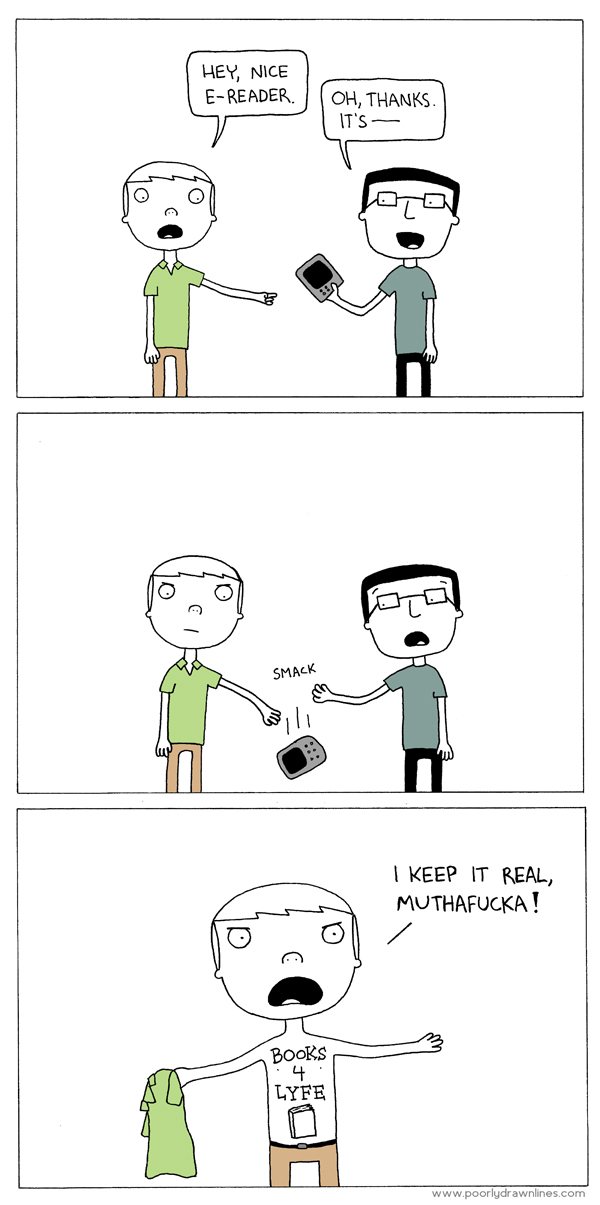
Additionally, McCloud severely underestimated consumers’ desire for tactile interaction. I’m no scientist, but there is definitely a sense of satisfaction and nostalgia that occurs when flipping pages of a printed book, and the difference in weight as the pages shift from your right hand to your left. While webcomics can experiment with new forms of tactile responses (such as vibration), it is impossible to recreate the feelings of weight and paper. As Poorly Drawn Lines suggests in its 2011 comic “E-reader”, the print media cult is still very much alive and active in our society.
The Best of Day 2: My favorite comics from the early stages of Poorly Drawn Lines
In “Webcomics”, Dr. Misemer discusses the prevalence of scholarly writing for webcomics, as well as how the medium deserves more complex analysis than it receives. Dr. Misemer argues that, because of the exponential rate at which technology is advancing, the approximately 20 years webcomics have been around demands as much scrutiny and study as hundreds of years of prose. Additionally, as webcomics can cover a wide breadth of topics and be created by both amateur and professional artists, Dr. Misemer argues that webcomic scholarship would not be limited to sophisticated writers. Instead, the marginalized audiences that have adopted webcomics as a primary outlet for their voice would be best suited to carry out these studies.
As this is the first blog post diving deeper into the comic of my choosing, I decided to start my research by reading the earliest comics available in the archive. Immediately, Dr. Misemer’s argument about the fast-moving history of webcomics was justified. While the comic itself was not dated, many of the comments were dated for seven years ago, which I used to estimate the year the comic was created. The comic, and the others I analyzed, were in a drastically different style than Reza Farazmand’s (the author) current work. The first aspect that stood out to me was the change in subject—Reza’s early comics were all focused on people instead of animals such as Kev and Ernesto that have become tell-tale signs of his work nowadays. Additionally, the old comics were black and white and used a drawing style that was more crooked and jagged, unlike the smooth curves of recent comics. To top it all off, the comics were generally much longer, and instead of dialogue used narrative style text. If a single author’s style can change so drastically in seven years, imagine how much change could be discovered in 20 across the entire category.
The first comic present in the Poorly Drawn Lines archive
Dr. Misemer’s plea for a larger representation of webcomics in academic writing is well justified. While the comic I am following has not directly been used as an outlet for marginalized voices (at least not yet), her claim is easily justifiable by the countless examples of comics given in the paper. Additionally, as technology becomes more advanced and the web becomes more expansive, webcomics are becoming increasingly popular. Instagram, Facebook, Twitter, and even GT Memes for Buzzed Teens are examples of how pervasive webcomics have become—and how important their continued study is.
The Best of Day 1: My favorite comics from the early stages of Poorly Drawn Lines
For my webcomic analysis, I have chosen to follow Poorly Drawn Lines. There are multiple reasons I have chosen to follow this website. First, my favorite comic I have read has come from this website (see comic below, written by poorlydrawnlines and found on imgur). The simplicity, yet hilarity of the comic (a trend that pervades through all of the author’s comics) has always brightened my mood no matter the situation. Secondly, as this is a semester long project, I wanted to make sure I would not run out of material to examine. Not only does the website have an expansive archive, but a new comic is posted every Monday, Wednesday, and Friday, so I should never run out of panels to examine. Thirdly, I wanted to find a webcomic that had an expansive field of influence. Not only does the website have comics, a blog, videos, and even a store, but the author runs an Instagram with over 1M followers, Facebook with 900k, and Twitter with 117k. This will allow me to not only examine posts and comments on the website, but also how the readers react to the comics on different platforms such as Instagram (and the comments that are found there). Finally, I wanted a webcomic series that I would enjoy reading repeatedly. In long, single storyline comics, I find myself getting bored and would therefore have a harder time analyzing the comic. With the quick, single comic stories of PDL, I can read 10 comics all with a different punchline yet be captivated the entire time, creating a better mental attitude when digging deeper into the comments and meanings.
From Poorly Drawn Lines, there are two different gains I believe we can obtain. The first is the ability to examine how the same content can induce different reactions depending on the platform. I am curious to see whether the comments of comics change depending on whether it’s viewed on the website, Instagram, or Facebook. Additionally, we can gain a storyline different from your typical story progression. While each comic has a different explicit story, the author reuses the same main characters throughout many of the comics—it will be interesting to identify how these characters tend to act/whether they implicitly tell a story throughout the multiple comics (see two comics below, found in poorlydrawnlines.com archive).





 Poorly Drawn Lines and Well Written Blogs